Playlist count is not a scoreboard
Ask how many playlists should a song be on and most artists expect a number. Ten? Fifty? Two hundred? The honest answer is that the number matters far less than the quality of the match and the timing of the adds. A track sitting on forty playlists that share the same listeners is not in a better position than a track sitting on eight well-matched ones. It is just noisier on paper.
Treat playlist volume as a curation decision. You are choosing where your song lives, who hears it, how often they hear it, and when. That framing changes what you accept and what you politely decline.
SebastianLoveInc Insight: A placement is only worth counting if it puts your track in front of listeners who would not otherwise have heard it, at a moment when they are likely to stay.
How many playlists should a song be on? Start with overlap
Playlist audiences overlap heavily. A listener who follows a mid-size indie pop list probably follows two or three others in the same lane. Curators in a niche often draw from the same pool of followers, and many listeners use several playlists as a rotation rather than one as a home base. When your track lands on five of those lists in the same week, one person can meet it five times before they have decided whether they like it.
This is playlist overlap for artists in practice. It is not a conspiracy and it is not a penalty. It is simply how curated listening works when thousands of playlists serve overlapping tastes. The question is whether that repetition works for you or against you.
What overlap looks like from the listener's side
From the listener's seat, repetition reads as either familiarity or fatigue. Meeting a song twice in a week can feel like the platform is onto something. Meeting it five times across five nearly identical playlists can feel like being marketed at. The difference usually comes down to fit: if the track genuinely belongs in that mood and genre, repeats feel natural. If it is bolted onto lists where it does not fit, repeats feel intrusive.
Does repetition help or annoy? Read skips and saves together
You cannot settle this with one number. Skips alone look alarming even for successful tracks, because plenty of listeners skip past a song to reach the one they opened the app for. Saves alone look encouraging even when the same small group is doing all the saving. Read them as a pair, over time, alongside completion behaviour.
Signals worth watching in Spotify for Artists, which stays the source of truth for streams, listeners, saves and playlist activity:
- Save rate rising while skip rate stays flat. Repetition is converting. Keep the placements running.
- Skip rate climbing while saves stall. You are probably overexposed in one overlapping cluster. Let some placements expire before adding more.
- Both flat. The adds are not reaching anyone new. The problem is reach, not repetition.
- Listener count rising but streams per listener falling. People are meeting the track once and not returning. That points at the song or the context, not the playlist count.
None of these readings is a verdict on the algorithm. They are just evidence about whether your current spread is doing work.
Genre fit beats playlist count every time
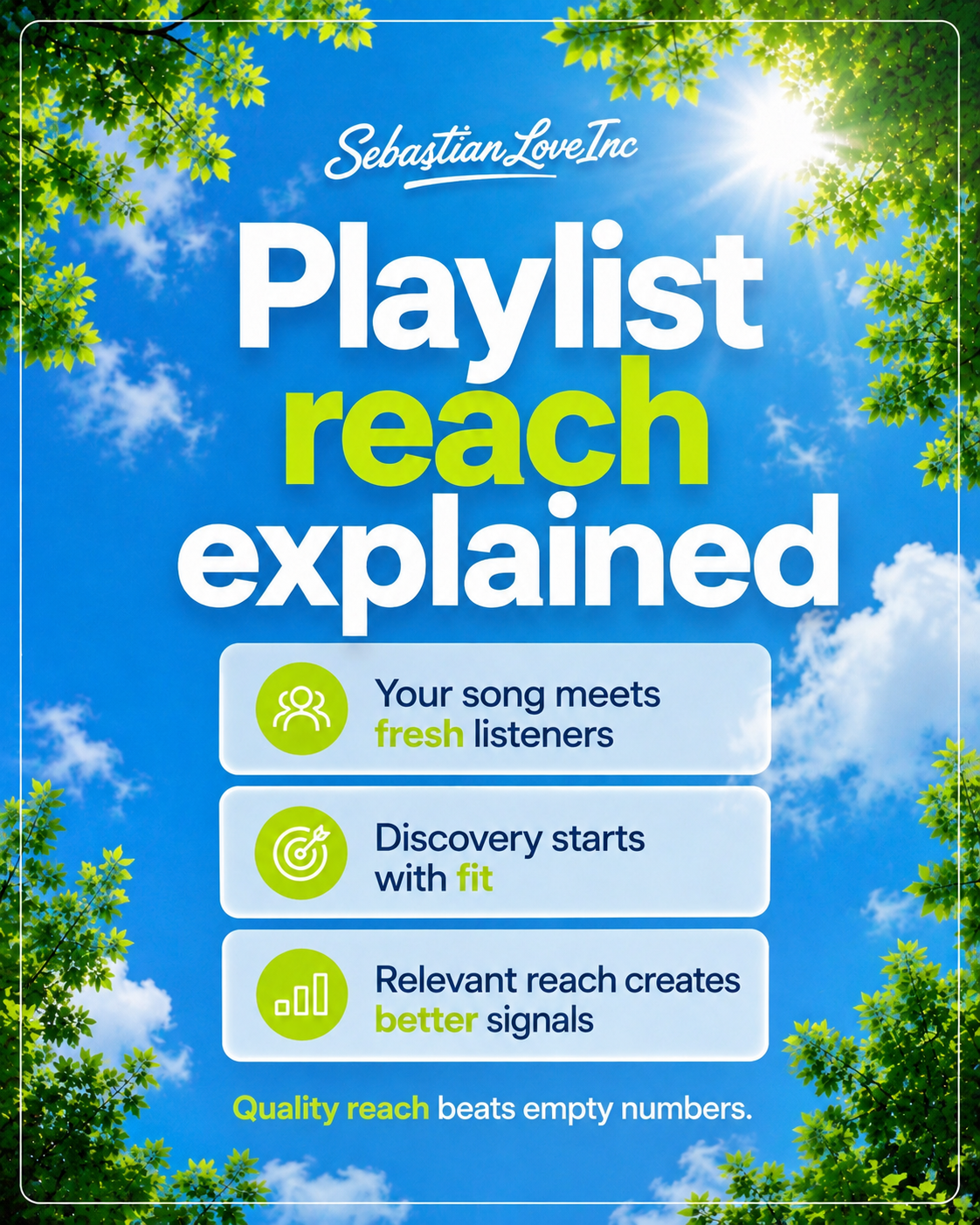
A track placed on two playlists that nail its genre, mood and tempo will usually outperform the same track scattered across fifteen generic lists. Curators with a tight identity have followers who opted in for exactly that sound. When your song fits, it stops being an interruption and becomes part of the reason someone opened the playlist.
This is why playlist reach depends on fit before follower counts. A 900-follower playlist built around your exact subgenre can deliver more real listening than a 40,000-follower catch-all list where your track is track 61 of 80. The big number looks better in a screenshot. The small, precise list often does more for your saves and repeat listens.
What a good match actually looks like
- The playlist's existing tracks sit within a narrow band of genre, tempo and energy.
- Your track would not feel out of place between the two songs around it.
- The curator updates the list regularly rather than leaving it frozen.
- The playlist's audience matches the region and language your music speaks to.
If you can tick most of those boxes, the placement is worth having. If you cannot tick any, the add is decoration.
How many placements is reasonable for a single release
There is no universal target, and anyone quoting one is guessing. What you can do is think in tiers and let the evidence decide whether to push further.
- Core tier. A handful of tightly matched playlists that define the sound world your track belongs to. These are the placements you would choose even if nobody was counting.
- Adjacent tier. Lists that sit one step out: a related subgenre, a mood playlist, a regional list. Useful for reaching listeners who would not find you in your home lane.
- Reach tier. Broader lists where your track is one of many styles. Fine in moderation, but this is where saturation usually starts.
For most independent releases, a core tier of a few strong fits plus a modest adjacent tier is a healthier plan than chasing a triple-digit add count. The number you end up with is an outcome of fit, not a goal you set in advance.
When a placement is technically real but adds nothing
Plenty of adds look good on a report and do nothing. Watch for lists that are tiny, dormant, or duplicated. A dormant playlist has not changed in months and its followers have stopped checking it. A duplicated list is one of several near-identical playlists run by the same operator, which multiplies your add count without multiplying your audience. Duplicate playlist placements are the most common reason an artist feels busy while their listener count sits still.
If you are reviewing a promotion report, check whether the playlists are distinct, active and genuinely in your lane before you judge the campaign by how many rows it contains. A short list of real placements beats a long list of echoes.
Sequence the adds instead of stacking them on day one
Timing is the lever most artists ignore. If every placement goes live in release week, you get one spike and then a cliff. Spread the same placements across the campaign window and you get several smaller waves, each reaching listeners who were not paying attention the first time.
Spreading a track across playlists over weeks also gives you something to learn from. If wave one produces saves and repeat listens, wave two is justified. If wave one produces nothing but skips, you have saved yourself the cost of the rest and can rethink the fit.
A simple sequencing shape
- Week 1–2: your strongest, tightest fits. These set the tone and give you a clean read.
- Week 3–5: adjacent lists, plus any curator who asked for a later slot.
- Week 6–8: broader reach lists, only if the earlier waves earned it.
This is roughly the window most campaigns run in, and it exists for a reason: it gives a release room to breathe instead of burning out in seven days. If you are working with a promotion partner, ask how they stagger adds rather than how many they can stack.
Audit what you already have before adding more
Once a track sits on a lot of playlists, the useful question changes from "how many more?" to "which of these are still working?" Pull up your placements and sort them by what they actually delivered: new listeners, saves, and completion. Then decide per placement.
- Keep pushing: lists that produced saves and repeat listens. Ask the curator about a longer stay or a follow-up slot.
- Let expire: lists that produced plays but no saves. Not every placement needs to become permanent.
- Stop pursuing: dormant, duplicated or off-genre lists. Remove them from your outreach list entirely.
This audit also tells you what to do next with the release. If your best placements are still converting, keep the campaign running. If everything has gone quiet, the answer is probably a new audience segment, not more of the same lists. That is the same logic behind keeping listeners after a playlist surge: the placement starts the relationship, it does not sustain it.
Accepting every offer is the real mistake
Most artists do not end up with bloated placement lists on purpose. They say yes to everything because saying yes feels like progress and saying no feels like turning down exposure. Over a few releases, that habit produces dozens of adds that generate almost no listening and a growing sense that promotion does not work.
A better default: accept placements that fit, decline the ones that do not, and keep a simple record of what each one produced. You will end up with fewer rows and more listeners. If you want to test a partner's approach before committing to a full run, a small trial campaign is a cheaper way to learn than a big one.
If you want help planning a spread that starts with tight fits and staggers the rest across the campaign window, you can start a campaign with SebastianLoveInc. Promotion can put your track in front of curated listeners and give you honest data about how they respond. It cannot make people like the song, guarantee streams, or turn a placement into a career. The listening still has to be earned.