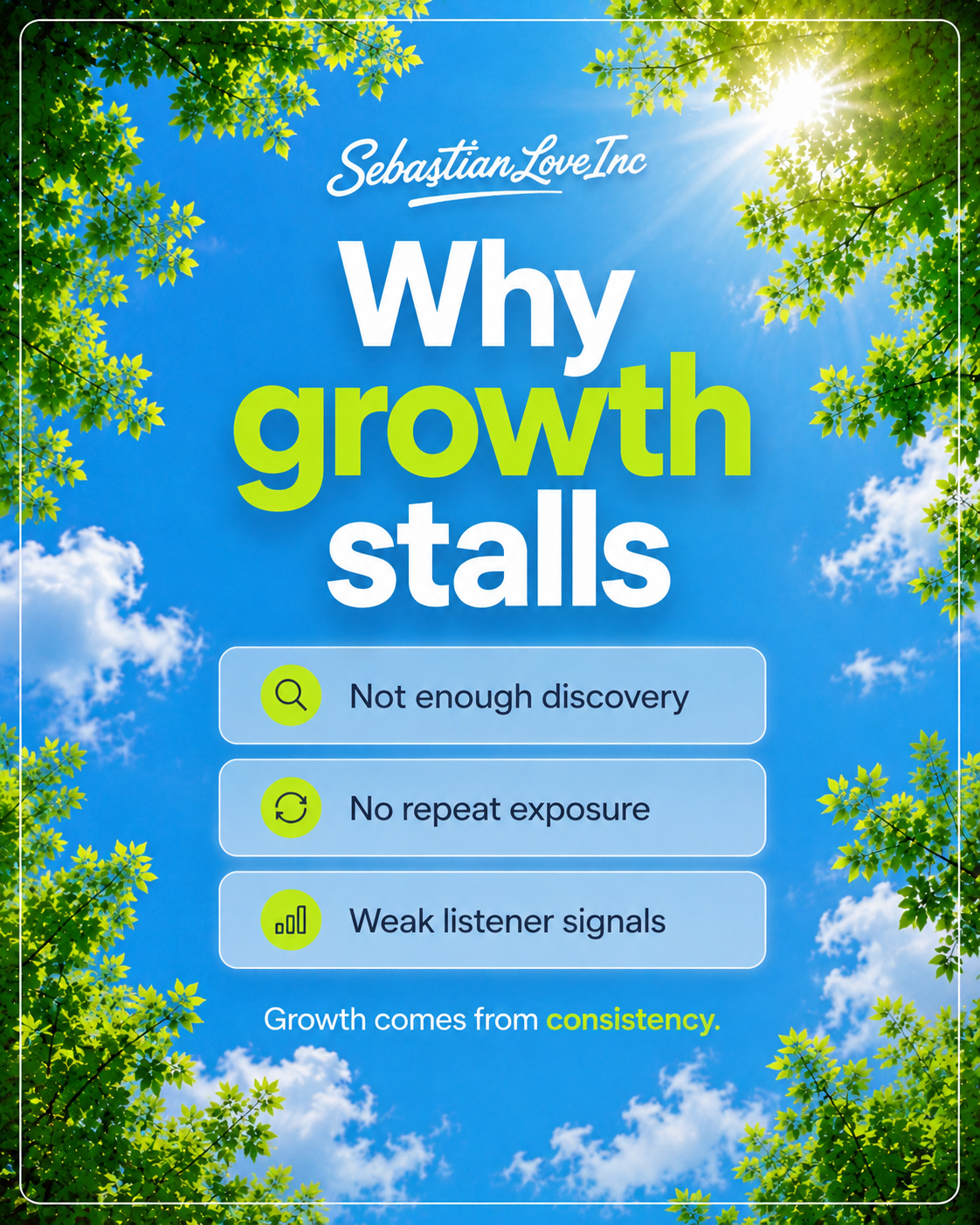
Flat numbers usually are not a mystery. In most catalogues they come down to three things: too few new people hearing the track, no reason for anyone to hear it twice, and too little signal from the people who did listen. None of this is fixed by a single campaign — but each part can be examined and worked on.
1. Not enough discovery
If almost all of your listening comes from people who already follow you, the catalogue has no inflow. Open Spotify for Artists and look at Source of Streams. Spotify separates active sources — your profile and catalogue, listeners' own libraries and playlists, and the listener queue — from programmed sources such as editorial and personalised playlists, algorithmic mixes, radio and autoplay, and playlists made by other listeners.
A release that is almost entirely active-source is being consumed by an existing audience. That is healthy, but it will not grow on its own.
2. No repeat exposure
One release week is a single moment. Discovery works better when a track keeps appearing over several weeks: playlist activity, your own posts, your artist profile, a follow-up release. A track that is heard once and never surfaced again has very little chance of becoming familiar.
3. Weak listener signals
Streams alone say little. Saves, follows and streams per listener tell you whether people came back. If reach went up but saves did not move, the problem is usually fit or the track's first thirty seconds, not volume. Spotify counts a song stream when someone plays it for at least 30 seconds, so early drop-off is invisible in your stream count but very visible in repeat behaviour.
A realistic diagnostic
Before changing anything, write down what you actually see in Spotify for Artists:
- Share of listening from active versus programmed sources.
- Saves and follower change during the release window.
- Streams per listener — did anyone repeat the track?
- Top countries and cities compared with where you promote.
- Whether listening dropped off immediately after release day.
A 30-day action list
Keep it small enough to finish.
- Week 1: fix profile basics — photo, bio, Artist Pick, correct metadata.
- Week 1: record your current baseline numbers so you can compare later.
- Week 2: choose one track with the strongest opening and make it the focus.
- Week 2: pitch any upcoming unreleased music to Spotify's editors yourself in Spotify for Artists, at least seven days before release.
- Week 3: run one focused promotion effort for the chosen track instead of spreading across five.
- Week 4: review saves, followers and Source of Streams against your baseline and write down what changed.
The takeaway
No signal guarantees algorithmic growth, and nobody can promise it. What you can do is make discovery possible, give the track more than one moment, and read the data honestly before spending again.
Ready to put this into practice? Start a SebastianLoveInc campaign — paste your Spotify link, pick a genre and mood, and we pitch your track to independent curators. Curators decide independently, and if no eligible playlist placement is secured during your paid campaign window, the campaign fee is refundable.