You paid for a campaign, the track went out to curators, and two weeks later you are staring at a stream counter trying to work out whether any of it did something. That gap — between what a promotion service does and what you can actually see — is where most frustration lives. Here is how Spotify playlist promotion works in practice, what happens behind the scenes, and which numbers tell you the truth afterwards.
What Spotify playlist promotion actually is
Playlist promotion means presenting your track to people who run playlists, so they can decide whether it belongs in theirs. That is the whole mechanic. A promotion service maintains relationships with independent curators, listens to your track, works out which playlists it genuinely fits, and puts it in front of those curators.
It is not a purchase of streams, and it is not a shortcut into Spotify's editorial playlists. Editorial pitching is free and happens inside Spotify for Artists — you do that yourself, ideally at least seven days before release. Independent curator promotion runs alongside it, not instead of it.
If a service describes a fixed number of streams as the product, you are not buying promotion. Promotion buys exposure and a decision; it cannot buy the outcome of that decision.
The three playlist types, and which one promotion can reach
Most confusion about playlist promotion comes from treating all Spotify playlists as one thing. They are governed by completely different systems.
| Playlist type | Who decides placement | Can promotion reach it? |
|---|---|---|
| Editorial | Spotify's editorial team | No — pitch free in Spotify for Artists |
| Algorithmic (Discover Weekly, Release Radar, Radio) | Spotify's systems | No — not directly placeable |
| User-generated | Independent curators and listeners | Yes — this is where outreach happens |
How a campaign runs, step by step
The sequence is fairly consistent across serious services. At SebastianLoveInc it looks like this:
- You submit the Spotify track link, your genre and the mood it belongs in.
- The track is reviewed — production, tempo, mood, and how the first thirty seconds land.
- A shortlist of curators is built from playlists that actually play this kind of music.
- Those curators are contacted manually and listen to the track.
- Each curator decides independently whether it fits their playlist.
- Placements are verified and logged, and the campaign window is monitored to its end.
Why fit matters more than follower counts
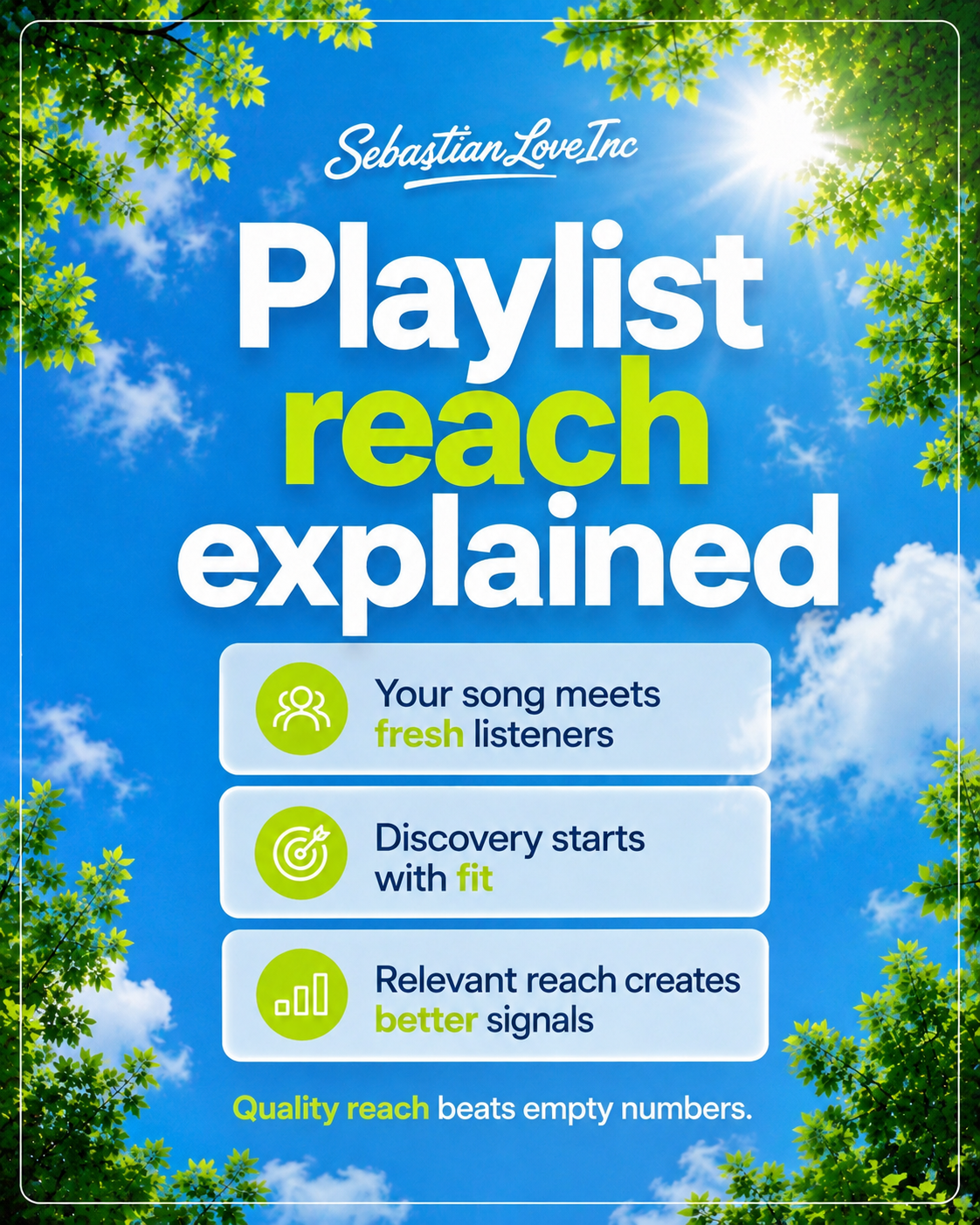
A placement on a 50,000-follower playlist that never plays your genre is worth less than a placement on a 2,000-follower playlist built around exactly your sound. Listeners who are not interested skip within seconds, and a skip teaches nobody anything about your music.
Follower counts are also the easiest number to inflate and the hardest to verify from the outside. What you can verify is your own side: what happened in Spotify for Artists while the track sat on those playlists.
What you can measure — and what a stream really is
Spotify counts a song stream once a listener plays it for at least 30 seconds. That single rule explains a lot: a track that loses people at second twenty can look quiet even when plenty of people opened it.
In Spotify for Artists, Source of Streams separates active sources (your profile and catalogue, listeners' own libraries and playlists, the queue) from programmed sources (editorial and personalised playlists, algorithmic mixes, radio and autoplay, and other listeners' playlists). Independent playlist activity generally appears under other listeners' playlists.
- Streams and unique listeners across the campaign window.
- Saves and playlist adds — the clearest sign a track landed.
- Streams per listener, as a repeat-listening indicator.
- Follower change during the window.
- Top countries and cities versus where you promote elsewhere.
Judge a campaign on saves and repeat listening before stream volume. Volume tells you how many people were exposed; saves tell you how many of them cared.
What nobody can honestly promise
Curators are independent people with their own taste and their own audience to protect. No service controls their decisions, and no service controls Spotify's algorithmic systems — the exact workings of those are not public, and they change.
So exact stream counts, editorial placements, algorithmic pickup, chart positions and follower growth cannot be guaranteed by anyone. What can be promised is the work and the exposure. SebastianLoveInc backs that with a placement promise: if no eligible playlist placement is secured for your track during the paid campaign window, the campaign fee is eligible for a full refund. Streams and listeners remain results, not guarantees.
Common mistakes artists make
Most disappointing campaigns share the same handful of causes.
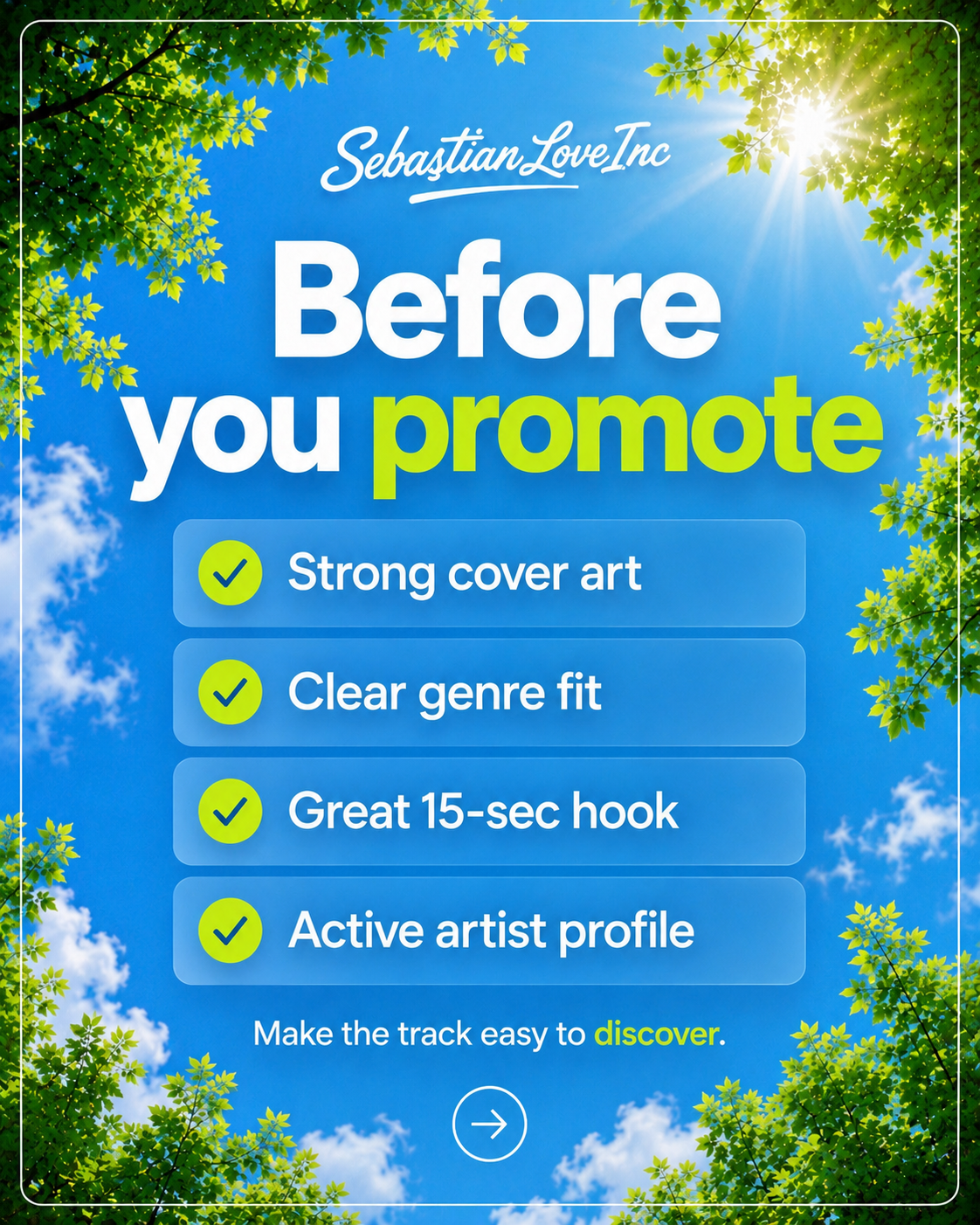
- Promoting a track before the artist profile, artwork or metadata is finished.
- Choosing a genre that sounds impressive instead of the one the track belongs to.
- Splitting a small budget across five tracks instead of backing one.
- Measuring on day three, when playlist activity builds over weeks.
- Never writing down a baseline, so no comparison is possible afterwards.
- Treating playlist promotion as the whole marketing plan rather than one part of it.
How to judge whether a campaign worked
Record your numbers the day before the campaign starts, then compare at the end of the window rather than daily. Look at whether new listeners arrived from programmed sources, whether saves moved with them, and whether anyone repeated the track. If reach went up and saves stayed flat, the honest conclusion is usually about fit or the opening of the song — not about volume, and more spend will not fix it.
The takeaway
Playlist promotion buys informed exposure and an honest decision from curators who actually play your genre — not a stream count. Get the release ready, back one track, record a baseline, then read saves and repeat listening in Spotify for Artists before you spend again.
Ready to put this into practice? Start a SebastianLoveInc campaign — paste your Spotify link, pick a genre and mood, and we pitch your track to independent curators. Curators decide independently, and if no eligible playlist placement is secured during your paid campaign window, the campaign fee is refundable.